
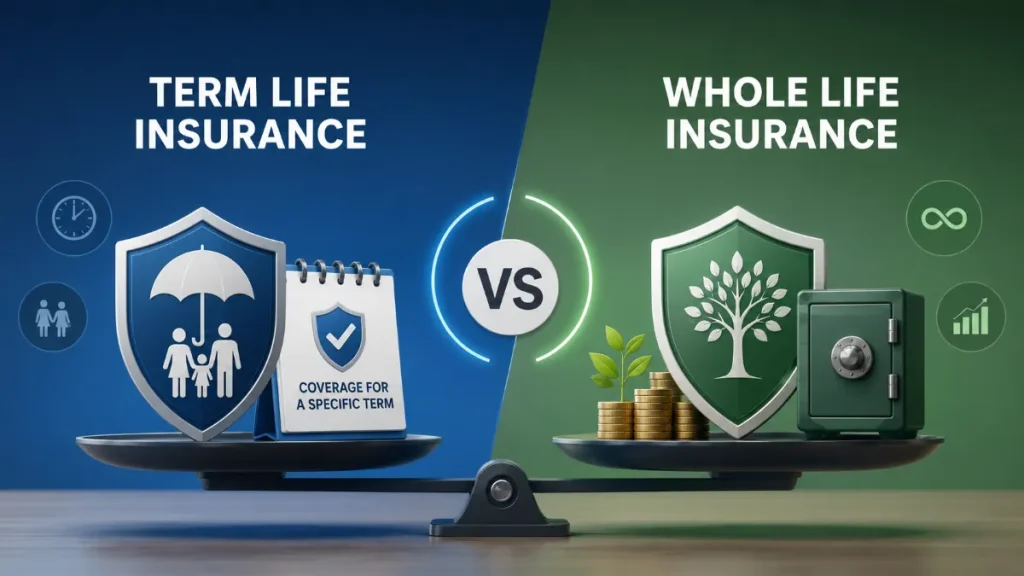
Term Life Insurance vs Whole Life Insurance is like renting protection for a defined period versus owning a lifelong financial contract. Usually, term life insurance costs less and covers a set number of years. By contrast, whole life insurance costs more but can remain active for life while building cash value. Therefore, the right choice depends on your coverage period, budget, dependents and long-term financial goals.
For many U.S. families, term coverage fits income replacement, mortgage protection and child-rearing years. Meanwhile, whole life may suit permanent estate planning, final expenses or people who value guaranteed cash value growth. In 2026, compare the policy’s guarantees, exclusions, renewal terms and total cost rather than choosing only by the premium shown in an online quote.
What is the difference between term life insurance and whole life insurance?
Term life insurance lasts for a specified period, while whole life insurance can last for the insured person’s entire lifetime when premiums are paid as required. In contrast, term insurance has no cash value component. Whole life insurance combines a guaranteed death benefit with cash value that grows according to a fixed interest rate.
| Feature | Term life insurance | Whole life insurance |
|---|---|---|
| Coverage length | Usually 1, 5, 10, 15, 20, 25 or 30 years | Permanent coverage for life |
| Premium pattern | Often lower during the chosen term | Typically higher but level throughout life |
| Cash value | None | Grows using a fixed interest rate |
| Death benefit | Paid only if death occurs during the active term | Guaranteed as long as policy requirements are met |
| Policy flexibility | Some policies permit renewal or conversion | Death benefit generally cannot be changed without policy changes |
Overall, the main trade-off is straightforward: term insurance prioritizes affordable temporary protection, whereas whole life insurance charges more for permanence and a cash value account. In addition, a policy illustration can show how premiums, cash value and death benefits may develop over time.
How does term life insurance work?
Term life insurance pays a death benefit to named beneficiaries if the insured dies during the policy term and the policy is in force. However, if the insured survives the term, the policy normally ends without a death benefit or cash value. As a result, that structure helps keep premiums lower than permanent coverage.
Available terms commonly include 10, 20 and 30 years. In addition, some insurers offer one-, five-, 15- or 25-year options. For example, a parent with a 20-year-old mortgage and dependent children may select a 20-year term so the policy covers the years when lost income could create the greatest financial strain.
What are the advantages of term life insurance?
- Lower premiums: Generally, term coverage costs less than permanent life insurance with the same death benefit.
- Simple purpose: The policy can focus on income replacement, debt protection or education funding.
- Conversion potential: Furthermore, some contracts allow conversion to permanent coverage without new medical underwriting.
- Renewal options: Certain policies permit renewal for another term, although the premium usually rises.
What are the drawbacks of term life insurance?
- No cash value: Unlike whole life insurance, premiums do not create a savings account inside the policy.
- Expiration risk: Consequently, survivors receive no death benefit when the term ends.
- Higher renewal cost: Renewal is often more expensive because the insured is older.
- Health-related pricing: Moreover, a new application or conversion may become less affordable after health changes.
Renewal and conversion rules vary by insurer. Therefore, read the policy carefully for deadlines, age limits, conversion restrictions and premium schedules. The National Association of Insurance Commissioners’ life insurance guidance is a useful starting point for reviewing policy terms and consumer questions.
How does whole life insurance work?
Whole life insurance is permanent coverage that can remain active for life when premiums are paid according to the contract. It includes a guaranteed death benefit and a cash value component that grows based on a fixed interest rate. As expected, the premium is usually higher than comparable term coverage.
The cash value may be accessed through policy loans or withdrawals. However, unpaid loans and withdrawals can reduce the death benefit and may affect the policy’s performance. For that reason, a policyholder should review interest charges, surrender costs and tax consequences with a qualified professional before taking money out.
What are the benefits of whole life insurance?
- Lifetime protection: Beneficiaries can receive a death benefit whenever the insured dies if the policy remains in force.
- Guaranteed cash value growth: In addition, the contract specifies growth based on a fixed interest rate.
- Level premiums: Premiums generally remain consistent throughout the insured’s lifetime.
- Possible dividends: Some participating insurers may pay dividends, but dividends are not guaranteed.
What are the limitations of whole life insurance?
- Higher cost: Whole life can cost substantially more than term coverage with a similar death benefit.
- Limited investment control: Policyholders usually cannot choose the underlying investments.
- Reduced benefit after borrowing: As a result, an unpaid loan or withdrawal may lower what beneficiaries receive.
- Less flexibility: The death benefit and premium structure are generally less adjustable than universal life insurance.
Final expense insurance is one form of whole life coverage. Usually, it offers a smaller death benefit intended for funeral and burial costs, out-of-pocket medical bills, legal expenses and accounting costs. It may be more affordable than larger whole life policies, but the benefit may not cover broader family needs.
Which costs more: term life insurance or whole life insurance?
Whole life insurance generally costs more because it provides permanent protection and includes cash value growth. The supplied comparison estimates that whole life may cost five to 15 times more than term coverage. Nevertheless, actual premiums depend on age, health, tobacco use, coverage amount, policy design and underwriting.
Sample rates should not be treated as personal quotes. For example, a $1 million, 20-year term policy may produce very different premiums for two applicants with different health histories. Online term quotes can provide an initial estimate, while whole life quotes typically require an agent and a detailed policy illustration.
| Cost question | Term life | Whole life |
|---|---|---|
| Why is the premium different? | Temporary risk with no cash value | Lifetime risk plus cash value features |
| Does the policy build savings? | No | Yes, under the policy’s contractual terms |
| Can the price change? | It depends on the term and renewal structure | Premiums are generally level if paid as required |
| How should you compare quotes? | Review term length, renewal cost and conversion rights | Review guarantees, cash value, fees, loans and dividends |
Do not compare only the first-year premium. Instead, calculate the total planned payments and examine what happens if you cancel, stop paying, renew, borrow against cash value or outlive the term.
Who should choose term life insurance?
Term life insurance may be a practical choice for people who need substantial coverage at a lower initial premium for a defined period. It often suits young families, homeowners with mortgages and workers whose income supports children or a partner.
Consider term coverage when you:
- Need income replacement until children become financially independent.
- Want protection for a remaining mortgage or other major debt.
- Prefer lower premiums over cash value features.
- Need coverage only during working years.
- Can invest separately through retirement or brokerage accounts.
For instance, a household with a new mortgage may prioritize a 20- or 30-year death benefit. The goal is not to create an investment account inside the policy. Instead, it is to protect the family’s financial plan during its most vulnerable years.
Who should choose whole life insurance?
Whole life insurance may be suitable when lifelong coverage matters more than a lower premium. It can support estate planning, final expenses, permanent care needs or a legacy goal that does not have a planned end date.
Consider whole life when you:
- Want a guaranteed death benefit as long as contractual premiums are paid.
- Value guaranteed cash value growth under the policy terms.
- Have enough income to maintain higher premiums over the long term.
- Want possible dividends from a participating insurer, understanding that dividends are not guaranteed.
- Need coverage for final expenses regardless of when death occurs.
Permanent coverage requires discipline. A policy that lapses after years of payments may produce a disappointing result, especially when loans, withdrawals or surrender charges are involved. Therefore, ask for a guaranteed and non-guaranteed illustration before signing.
What alternatives exist besides term and whole life insurance?
Universal life insurance is another permanent option with a cash value component. Unlike whole life insurance, universal life usually offers adjustable premiums and an adjustable death benefit. Depending on the policy type, its cash value may be linked to a money market rate, market index or selected investments.
| Policy type | Main strength | Main concern |
|---|---|---|
| Term life | Lower-cost temporary protection | Coverage may end without a payout |
| Whole life | Permanent coverage and fixed cash value growth | Higher premiums and limited investment control |
| Universal life | Adjustable premiums and death benefit | Cash value may decline if performance or funding is inadequate |
Some universal policies include a minimum interest floor. However, that floor may come with a cap that limits growth. Market-linked or investment-based returns are not guaranteed in the same way as whole life’s fixed cash value growth, so policy documents deserve close attention.
What steps should you follow before buying a policy?
The most useful comparison starts with the financial risk rather than the product name. Therefore, a coverage amount should reflect income needs, debts, dependents, education goals, final expenses and existing assets.
- Set the coverage purpose. First, decide whether the policy protects income, a mortgage, final expenses or an estate.
- Choose the coverage period. Next, match the term to the years of financial dependence or the length of a major debt.
- Request comparable quotes. Use the same death benefit and term when comparing insurers.
- Review policy guarantees. Then, check premiums, exclusions, renewal terms, conversion rights and cash value assumptions.
- Check insurer strength. Also, review current financial-strength information from independent rating agencies.
- Read the illustration. Separate guaranteed values from projected dividends or other non-guaranteed figures.
- Reassess after major changes. Finally, marriage, divorce, a new child, a home purchase or retirement may change the needed coverage.
Insurance should fit the wider household plan. If you are also comparing other forms of protection, our guide to Best Car Insurance Companies in the USA covers a separate insurance decision and should not be used as a substitute for life insurance advice.
What mistakes should you avoid when comparing life insurance?
- Buying only by price: The cheapest quote may have weaker conversion rights or a shorter useful term.
- Ignoring inflation: Over time, a fixed death benefit may buy less than it does today.
- Assuming dividends are guaranteed: Whole life dividends depend on the insurer’s performance and policy terms.
- Borrowing without a repayment plan: Consequently, policy loans can reduce the death benefit and increase lapse risk.
- Choosing an unsuitable term: A 10-year policy may expire while children, debts or income needs remain.
- Overlooking beneficiary details: Beneficiary designations should be reviewed after major family or legal changes.
- Skipping the free-look period: State rules may provide a limited period to review and return a policy.
A practical test is to ask what would happen if your income stopped tomorrow. If the answer points to a temporary financial gap, term insurance may address it efficiently. On the other hand, if the need continues regardless of age, permanent coverage may deserve closer review.
Frequently asked questions about Term Life Insurance vs Whole Life Insurance
What happens after 20 years of paying whole life insurance?
After 20 years of paying whole life insurance, the policy can remain active for life when premiums and other requirements are met. Meanwhile, the cash value may have accumulated through the policy’s fixed interest structure. Beneficiaries can receive the death benefit when the insured dies, subject to the contract.
Is term life insurance better than whole life insurance?
Neither policy is universally better. Term life insurance may be better for affordable income protection during a defined period. In contrast, whole life insurance may be better for permanent coverage and guaranteed cash value growth. The appropriate option depends on budget, dependents, debts and long-term goals.
Why does whole life insurance cost five to 15 times more?
Whole life insurance generally costs more because it provides lifelong coverage and includes a cash value component. By comparison, term insurance covers a limited period and does not build cash value. The actual difference varies with age, health, policy size, insurer and contract design.
At what age should you stop term life insurance?
There is no universal age. You may reconsider term coverage when children no longer depend on you, the mortgage and other debts are paid, you have no intended inheritance or charitable need, and you can cover final expenses from available assets.
Can you borrow money from a whole life policy?
Many whole life policies allow loans or withdrawals from cash value. However, unpaid amounts can reduce the death benefit and may affect policy performance. Therefore, review interest charges, surrender values and possible tax consequences before accessing the cash value.
What is the best life insurance company in 2026?
There is no single best insurer for every applicant. A comparison cited in the supplied information identifies MassMutual as a highly rated option and notes an AA+ S&P Global rating as of January 2026. Nevertheless, verify current ratings, available products, state approval and policy guarantees before applying.
Can term life insurance become whole life insurance?
Some term policies include a conversion option that lets the policyholder move to permanent coverage without new medical underwriting. However, conversion deadlines, eligible products and premium changes vary. Check the policy contract rather than assuming every term policy offers this feature.
Conclusion
Term Life Insurance vs Whole Life Insurance comes down to duration, cost and cash value. Usually, term coverage is the more affordable way to protect income, a mortgage or dependents for a defined period. Whole life costs more but offers permanent protection and contractual cash value growth.
Start by identifying the years when your household would face the greatest financial loss. Then compare coverage amounts, policy guarantees, renewal terms and long-term affordability. Because state rules and contract language differ, review the final policy with a licensed insurance professional and confirm current information before purchasing.
