
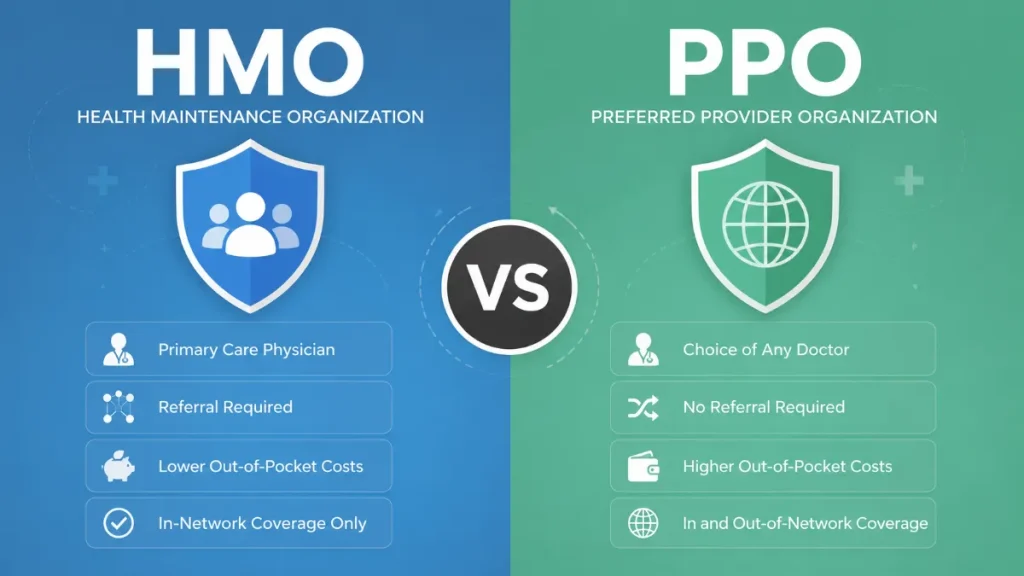
HMO vs PPO: What Is the Difference Between These Health Insurance Plans? The main difference is flexibility. Usually, an HMO limits you to a specific doctor network and requires a referral for specialist care. By contrast, a PPO normally lets you choose doctors directly, including some outside the network. However, that greater freedom usually means higher monthly premiums, deductibles and out-of-pocket costs.
Although HMO and PPO are widely used health insurance terms, they mainly describe US-style private health plans. In the UK, the healthcare structure is different because NHS treatment is generally funded through taxation. Even so, these plan features still matter if you are comparing international cover, employer-provided insurance or a private medical insurance policy with managed-care rules.
How does HMO vs PPO work in practice?
With an HMO, you normally choose a primary care doctor from the plan’s network. That doctor becomes your main point of contact for routine treatment and usually decides whether you should see a specialist. In contrast, a PPO does not generally require a primary care doctor. As a result, you can arrange an appointment with a specialist yourself.
The practical difference becomes clear when you need care. For example, someone with recurring joint pain may need to see an orthopaedic specialist. Under an HMO, the patient would usually contact the primary doctor first and obtain a referral. With a PPO, however, the patient can often book the specialist directly.
What does an HMO cover?
An HMO provides care through a defined network of doctors, hospitals and other healthcare providers. Treatment outside that network is generally not covered unless it is an emergency. Therefore, this narrower choice helps the insurer control costs. That is why HMOs commonly have lower monthly bills and lower deductibles.
That structure can work well for someone who lives near suitable network providers and does not mind following a managed-care process. However, checking the network before enrolling is essential. For instance, a nearby hospital, consultant or clinic may not be included even if it accepts other insurance plans.
What does a PPO cover?
A PPO gives you more freedom to choose doctors and hospitals. Usually, you can see a specialist without a referral. The plan may also pay part of the cost when you use an out-of-network provider. Nevertheless, you will normally pay more for that flexibility through higher premiums, deductibles or coinsurance.
For instance, a person who regularly travels between England and another country may value direct access to recognised specialists. Even then, a PPO does not mean unlimited free treatment. The policy can still include provider restrictions, annual limits, exclusions and different reimbursement levels for in-network and out-of-network care.
What are the key differences between HMO and PPO plans?
HMO and PPO plans differ across four practical areas: primary-care requirements, specialist referrals, out-of-network cover and cost. The table below provides a quick comparison. However, the policy wording remains the final source for claims, exclusions and payment rules.
| Feature | HMO | PPO |
|---|---|---|
| Primary care doctor | You must usually choose a main doctor from the network. | You do not generally need to select a main doctor. |
| Specialist referrals | A referral from your main doctor is usually required. | You can generally book a specialist directly. |
| Out-of-network care | Usually not covered, except for emergencies. | Partial cover may be available, usually at a higher personal cost. |
| Monthly cost | Usually lower monthly payments. | Usually higher monthly payments. |
| Deductible | Often lower, depending on the policy. | Often higher, depending on the policy. |
One useful way to compare plans is to separate predictable costs from possible costs. The monthly premium is predictable, while a deductible, consultation fee or out-of-network bill may only arise when you claim. Consequently, a cheaper HMO can become less suitable if its network does not include the providers you need.
Which plan is better for long-term healthcare needs?
The better plan depends on how you use healthcare, where you live and how much choice you need. An HMO may suit a person who wants lower regular payments and expects to receive most care close to home. On the other hand, a PPO may suit someone who values direct specialist access or travels frequently.
When should you choose an HMO?
An HMO may be appropriate when keeping monthly costs under control is a priority. It can also suit people who are comfortable choosing one main doctor and following a referral process before seeing an expert. In practical terms, the structured route may be worthwhile when specialist care is occasional.
- Choose an HMO if you want lower monthly payments.
- It may suit you if you do not mind seeing a main doctor before specialist treatment.
- The plan can be practical when you expect to stay close to home for care.
- Before enrolling, review the provider directory if you already use a particular hospital or consultant.
Consider a new employee choosing cover through a US-based employer. If the employee rarely sees specialists and the local network includes a preferred GP and hospital, the HMO’s lower recurring cost may provide better long-term value. In that situation, paying for flexibility that is rarely used may not be worthwhile.
When should you choose a PPO?
A PPO may be a stronger fit when freedom of choice matters more than the lowest monthly bill. It can also be useful for people who travel often, live in two places or need frequent specialist care without waiting for a referral. Therefore, the higher premium may be justified when provider access is a regular concern.
- Choose a PPO if you want to book specialists directly.
- It may suit you if you travel frequently or divide your time between two locations.
- Consider it when you need regular specialist treatment and want faster access.
- Before assuming a provider will be affordable, check the out-of-network reimbursement.
For a UK reader, the distinction may arise in an international policy rather than an ordinary NHS choice. Private medical insurance in Britain often uses different terms. Therefore, compare the insurer’s actual rules instead of assuming that every private policy operates like a PPO.
What should UK readers check before choosing a health plan?
Start with the policy schedule and provider directory, not the plan label. HMO and PPO descriptions can vary between insurers. For example, a plan that appears flexible may still require pre-authorisation, apply separate excesses or restrict treatment to approved hospitals.
- Check the provider network: Confirm that your preferred GP, hospital, consultant and diagnostic centre are included.
- Review referral rules: Find out whether specialist appointments need approval from a primary doctor.
- Compare total costs: Look at premiums, deductibles, excesses, copayments and out-of-network charges.
- Read emergency provisions: Verify how urgent treatment is handled outside the normal network.
- Check pre-authorisation: Some procedures require insurer approval before treatment begins.
- Review exclusions: Pay attention to pre-existing conditions, waiting periods and outpatient limits.
UK consumers should also distinguish private medical insurance from NHS entitlement. The NHS guidance on private healthcare explains how private treatment relates to NHS services. For a particular policy, read the insurer’s documents and verify current terms before purchasing.
For background on how private cover is structured in Britain, see Private Health Insurance Work in the UK. The same careful approach applies: compare the benefits, limitations and claim conditions rather than relying only on a product name.
What are the advantages and disadvantages of each plan?
Neither plan is automatically the better choice. Instead, the right option balances access, location and predictable spending. A plan with a low premium may be poor value if you repeatedly pay for excluded providers. Conversely, a flexible plan may cost more than necessary for someone who uses only routine care.
| Plan | Advantages | Disadvantages |
|---|---|---|
| HMO | Lower monthly cost, lower deductible in many cases and coordinated care through a main doctor. | Limited network, referral requirements and little or no routine out-of-network cover. |
| PPO | Direct specialist access, broader provider choice and partial out-of-network cover. | Higher monthly cost, potentially higher deductible and greater personal spending outside the network. |
What common mistakes should you avoid?
The most common mistake is comparing only the monthly premium. That figure does not show what you might pay when treatment is needed. Furthermore, a second mistake is assuming that emergency cover and ordinary out-of-network care follow the same rules. In practice, they often do not.
- First, check whether your current doctor is included instead of assuming automatic cover.
- Also, do not treat “out-of-network cover” as full reimbursement.
- Before comparing premiums, include the deductible in your calculations.
- For a planned procedure, check authorisation requirements before booking treatment.
- Finally, do not confuse an HMO or PPO label with the way UK private medical insurance is normally organised.
Keep a simple comparison sheet with five headings: monthly premium, deductible, provider access, referral rules and out-of-network payment. This takes only a few minutes and makes hidden trade-offs easier to see. It is especially useful when two policies use similar marketing language.
What do experts suggest when comparing HMO and PPO cover?
A sensible comparison begins with your expected healthcare pattern rather than an abstract preference for choice. First, list the doctors you already use. Then estimate how often you need specialist care and identify where you are likely to receive treatment during 2026.
Next, test both plans against one realistic scenario. Imagine a consultation, a diagnostic scan and a specialist appointment. Check which provider each plan uses, whether a referral is needed and what you would pay before insurance contributes. As a result, this method gives a clearer picture than comparing premiums alone.
Frequently asked questions about HMO vs PPO
Is an HMO cheaper than a PPO?
An HMO usually has lower monthly premiums and lower deductibles than a PPO. However, the final cost depends on the policy, your healthcare use, the provider network and any out-of-network treatment. Therefore, always compare the full cost structure rather than the premium alone.
Can you see a specialist directly with an HMO?
Usually, no. An HMO generally requires you to see your chosen primary care doctor first and obtain a referral. Nevertheless, the exact process can vary. Check whether the policy makes exceptions for certain specialists or services.
Does a PPO cover out-of-network doctors?
A PPO generally provides partial cover for out-of-network doctors. You may still face a higher deductible, larger coinsurance payment or balance billing. For that reason, confirm the reimbursement rules before arranging planned treatment outside the network.
Do PPO plans require a primary care doctor?
A PPO normally does not require you to choose a primary care doctor. Usually, you can arrange specialist care directly. Even so, a policy may still encourage coordinated care or require approval for particular procedures.
Which plan is better for someone who travels often?
A PPO may be more suitable because it offers broader provider choice and partial out-of-network cover. However, travel benefits vary widely. Check geographic limits, emergency arrangements and whether treatment outside the main service area is reimbursed.
Are HMO and PPO plans standard UK health insurance products?
No. HMO and PPO are mainly US health insurance categories. In contrast, UK private medical insurance often uses different arrangements, while NHS care follows a separate public system. UK buyers should read the policy wording and confirm the insurer’s network and referral rules.
Conclusion
Choose an HMO when lower monthly payments, local care and a structured referral route match your needs. Choose a PPO when direct specialist access, wider choice and travel flexibility justify higher costs. In either case, compare the network, deductible, exclusions and out-of-network rules before enrolling.
For UK readers, the plan label is only a starting point. Ultimately, the durable choice is the policy whose access rules and total costs fit your real healthcare pattern in 2026. If the wording is unclear, ask the insurer for a written explanation before making a decision.
